Using this feature, Forms Data Loader can load data accurately and several times faster than Macro Loading. It's more reliable — the load stops whenever an error occurs, because although the load is built using Forms Data Loader, it's executed by Oracle Forms.
This method applies to Oracle Java Applet Forms (also known as Oracle Traditional Forms or Oracle Core Forms). It is not applicable to Oracle Web-Based Forms / Oracle OAF forms — for those, please use HTML Forms Data Loader, which is specially built for web forms.
Using this method, you can load data in Oracle Apps by performing the following steps.
Step 1 — Record Sample Data
In a Windows client, log in as the user for whom you'll turn on recording, open the required form, and enter at least 2 sample records, following the guidelines below.
Guidelines for Recording Loads
- Enter at least 2 similar records — i.e., enter data in the same number of fields, in the same order, in both records.
- If you entered data in 10 fields in the first sample record, enter data for 10 fields in the second record too. Don't skip fields or use extra fields.
- Don't use different methods to select check boxes or radio buttons between the two records — if you used the mouse for the first, use the mouse for the second too (same for keyboard).
- Use keyboard shortcuts as much as possible instead of mouse clicks while recording
- Enter data directly in LOV fields as much as possible, instead of selecting from LOVs
- Do not switch between forms while recording
- Exit the Oracle Application as soon as you finish entering sample records
- For drop-down lists, enter as many sample records as the different values you want to use
Step 2 — Identify the Repeating Section
Open the recorded file in Forms Data Loader. FDL will ask you to identify the First Field and Last Field of the repeating section, as shown below. Select the first and last repeating fields of the first sample record you entered while recording.
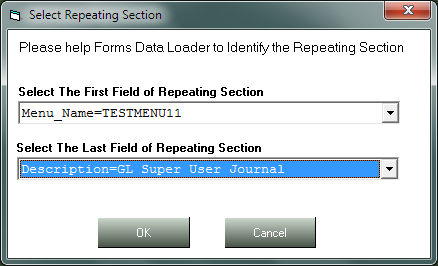
Accurately selecting the first and last field of the repeating section is crucial for correct execution of the load.
Step 3 — Review the Spreadsheet
Once you've identified the first and last field of the repeating section, Forms Data Loader shows a spreadsheet with the records you entered in the form, as shown below.
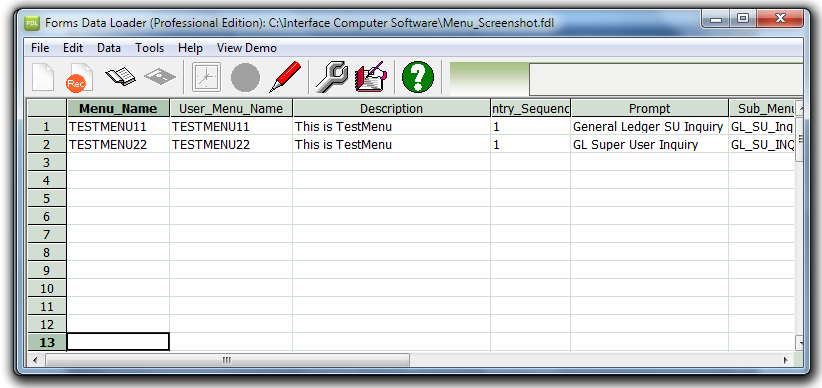
Now you can add records to the spreadsheet by typing directly, importing from Excel/CSV files, or from any delimited file. You can also copy and paste data from any spreadsheet.
Once you've populated the spreadsheet, save the file. When you save, Forms Data Loader generates the code necessary to play the file in Oracle Forms — click the  button to view the code.
Step 4 — Deploy the Playback File
Take this file to the machine where the forms server is running and copy it to the location usually at $COMMON_TOP/admin/log, giving it the name specified in the "play=" option in profile settings when configuring Oracle Forms for Record and Playback.
If you can open forms directly without going through sign-on pages, you can type the record and play file into the address itself, for example:
In UNIX:
http://host.domain:port/dev60cgi/f60cgi?record=rec.fdl%20play=myplay.fdl
In Windows:
http://host.domain:port/dev60cgi/ifcgi60.exe?record=rec.fdl%20play=myplay.fdl
Oracle Forms will start loading the records as soon as the form opens. Step 5 isn't needed if you're opening the forms directly this way.
Step 5 — Log In and Play Back
Log in to the Oracle Application as the user for whom you set the profile setting for playback, and open the desired form. Oracle Forms will start loading the records as soon as the form opens.